Women own 14.2 million U.S. businesses, according to the U.S. Census Bureau. Even so, finding the right one to grow your marketing takes more legwork than most founders expect.
The fastest route to a women-owned marketing partner for a growing business starts with your growth goals. From there, build a shortlist from verified directories and certifiers, confirm ownership through WBENC or SBA records, and test the fit with a short pilot before you sign a long retainer.
We see the same moment again and again. A company outgrows the freelancer who built its first website, or the agency that hands every client the same package, and suddenly it needs a partner who cares where the business is headed. For a lot of founders, that partner is a woman-owned business whose leaders see audiences and communities differently and build campaigns to match.
Claiming "women-owned" takes one line on a website. Proving it takes paperwork. Most searches for the best woman owned digital marketing agency start with a list, and we think they should start with a process.
TL;DR Quick Answers
Best Woman Owned Digital Marketing Agency
The best woman owned digital marketing agency is one that women own and run, can prove it with WBENC or SBA certification, and has already scaled clients at your stage. For Los Angeles brands, the strongest fit adds a multicultural lens to public relations, social media and event marketing.
What to look for:
Verified ownership: women hold at least 51 percent and run the business, backed by a current WBE or WOSB certificate.
Growth-stage proof: case studies with metrics and references from clients at your revenue level.
Connected services: PR, social, paid, content, events and growth consulting working from one strategy.
Multicultural insight: campaigns built to connect across communities, not just one audience.
Agility: a smaller team that adapts fast and gives you direct access to decision-makers.
A low-risk start: a 60 to 90 day pilot with agreed KPIs before any long retainer.
Top Takeaways
Women must own at least 51 percent of a women-owned agency and run it day to day.
Check certification with WBENC or the SBA instead of relying on the agency's website.
Build your shortlist from certifier databases, review directories and referrals.
Test growth-stage fit by looking at capacity, account continuity and how the services work together.
Run a 60 to 90 day pilot before you commit to a long retainer.
What Counts as a Women-Owned Marketing Partner?
A women-owned marketing agency is one where women hold at least 51 percent of the ownership and also run the business. That second part matters. Women have to manage daily operations and make the long-term calls, not just appear on the paperwork.
Two designations show up most often. The Women's Business Enterprise National Council (WBENC) certifies Women's Business Enterprises, or WBEs, after reviewing who owns and controls the company, and certified firms renew every year. The U.S. Small Business Administration runs the Women-Owned Small Business (WOSB) program, along with an Economically Disadvantaged (EDWOSB) category, for small businesses that want to compete for federal contracts.
Plenty of women-owned agencies have never pursued certification. That says nothing about their talent. You'll just need to ask a few more questions to confirm what they tell you.
Why Growing Businesses Seek Out Women-Owned Agencies
When growing businesses tell us why they want a women-owned partner, their answers usually come down to these reasons:
Perspective. Women-led agencies often bring lived experience to audiences that mass-market campaigns miss. Many pair it with a multicultural lens, so a message connects across communities instead of landing with just one.
Procurement. If you sell to corporations or government agencies, supplier diversity counts. The federal government aims to award at least 5 percent of its contracting dollars to women-owned small businesses, and many corporate buyers track what they spend with certified WBEs. A certified partner can strengthen your own diversity reporting.
Pace. Smaller, independent agencies can usually change direction fast. You deal with fewer layers and talk directly to the people making decisions about your account.
One honest caution. We haven't seen reliable research proving that women-owned agencies automatically deliver better results. The value comes from fit, and you can test fit before you commit to working with ESG digital marketing and advertising agencies.
How to Find a Women-Owned Marketing Partner in Six Steps
Take these steps in order. Each one trims your list, so your time goes to partners who can support your next stage.
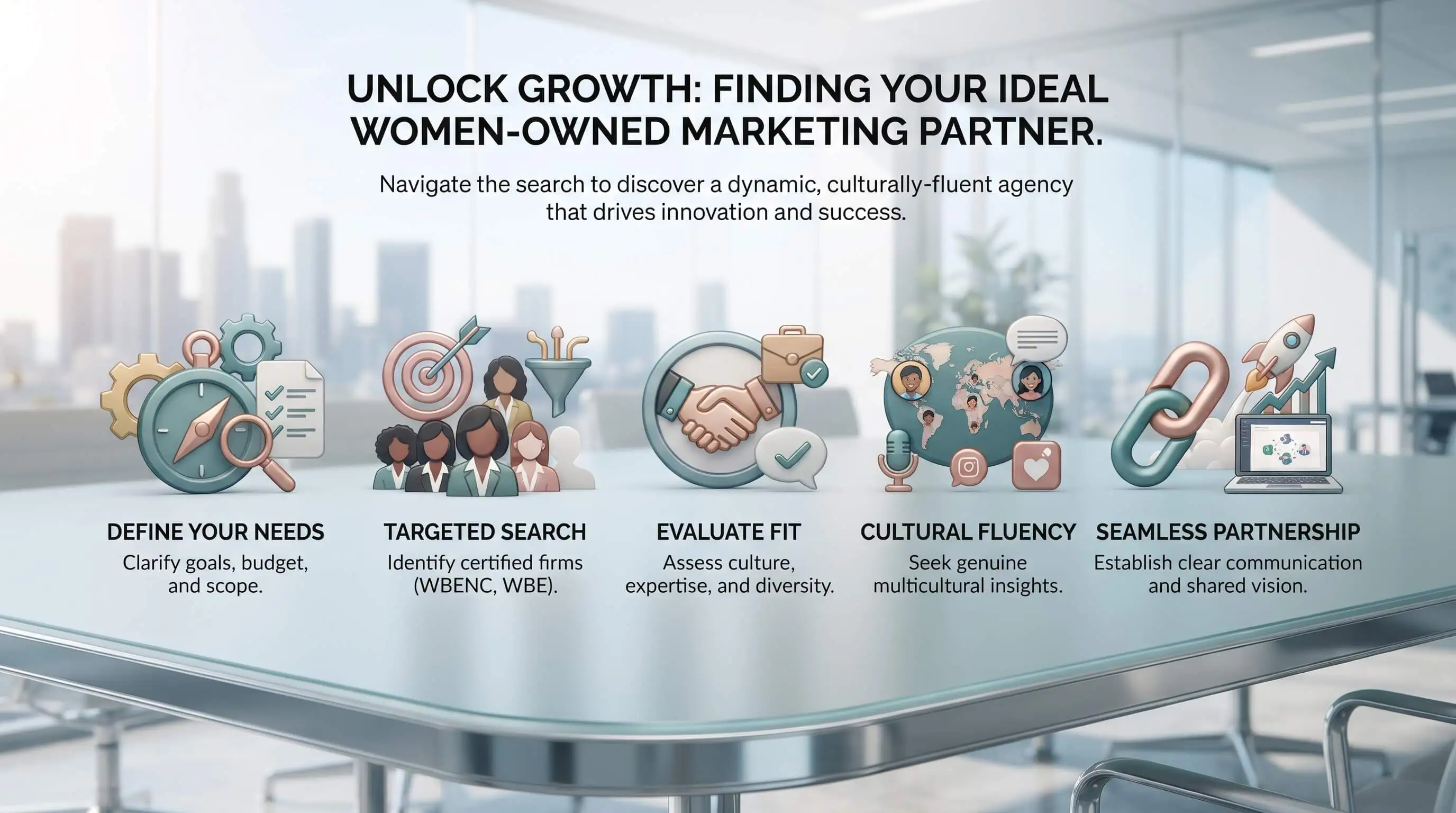
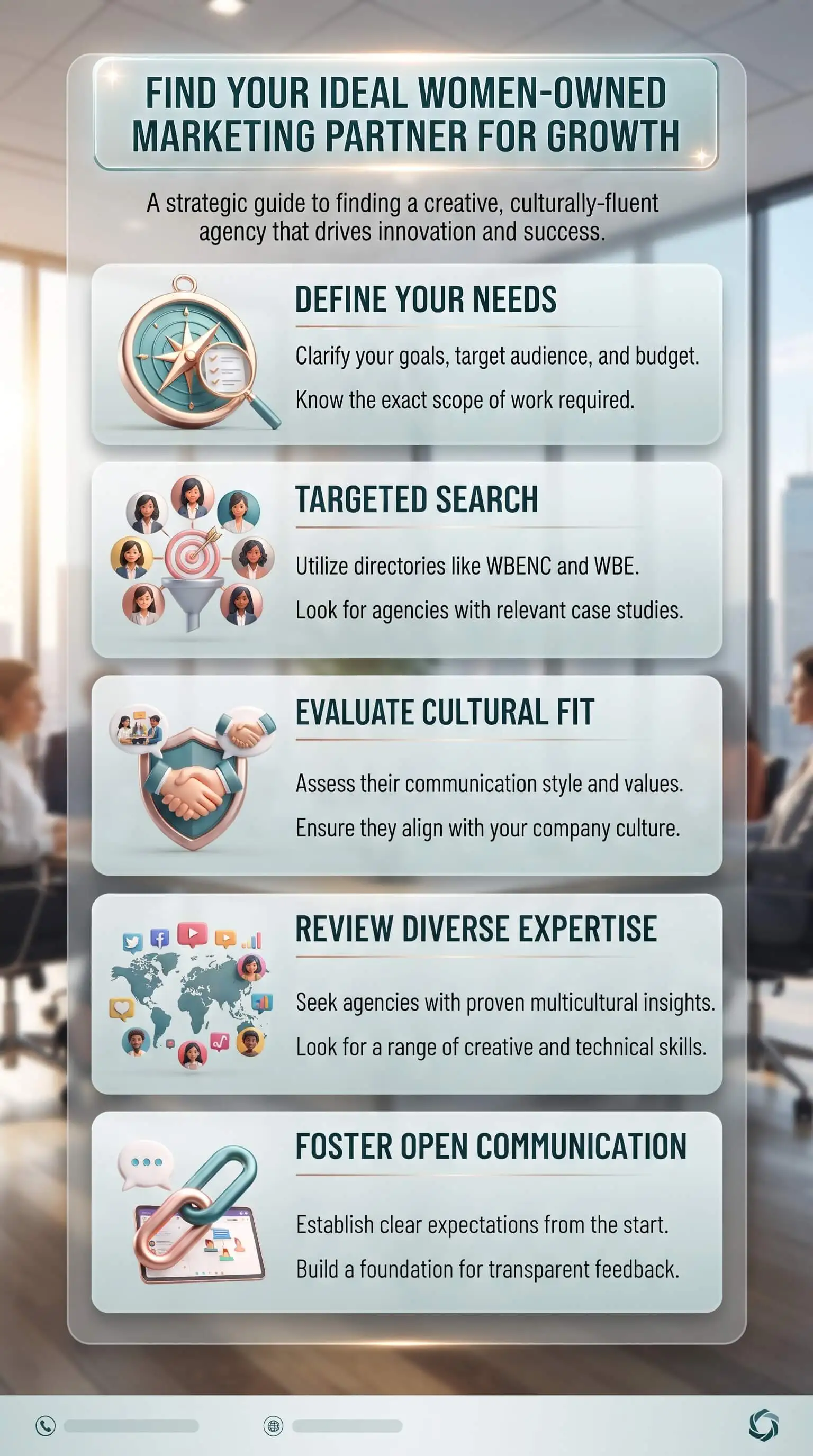
Step 1: Define Your Growth Goals and Marketing Gaps
Write a one-page brief before you call anyone. Put down your revenue targets for the next 12 to 24 months, the channels already working, the skills your team is missing, a budget range and your timeline. Agencies write sharper proposals when they can see what success looks like. You get a yardstick for comparing them.
Step 2: Build a Shortlist From Verified Sources
Begin with WBENC's directory of certified businesses. Clutch helps too, since it lets you filter women-owned agencies by city and service. Ask peers and your local chamber of commerce for referrals, and aim for five to seven names. New to agency searches? Our guide on how to find the right marketing company for your business walks through the basics.
Step 3: Confirm Ownership and Certification
Ask every agency for its certificate, then check it with the organization that issued it. Look at the date, because WBENC certification renews annually. If an agency isn't certified, ask who owns the company and who runs it day to day. Keep certification in perspective, though. It confirms ownership, and WBENC itself says it doesn't guarantee contracts. Quality is a separate question.
Step 4: Test Growth-Stage Fit and Capacity
Ask what would happen if your workload doubled within a year. Then look at how deep the team runs, who would lead your account and whether that person is likely to stay. Most growing businesses need public relations, social media, paid media, content and events working together, and one channel sold as a cure-all won't get you there.
Step 5: Review Proof of Results
Ask for case studies that show where the client started, which metrics moved and how long it took. Call two references at roughly your stage. Find out what reporting looked like in month three, well after the kickoff energy faded.
Step 6: Start With a Scoped Pilot
Run a 60 to 90 day pilot with agreed KPIs. It will teach you more than any pitch deck. Within a few weeks, you'll see how the team communicates, how quickly it adjusts and whether its reports connect to leads and revenue.
What Sets the Best Woman Owned Digital Marketing Agency Apart
The strongest women-owned partners can show you their ownership papers and their growth results. Compare your shortlist against these criteria.
Ownership: Documented 51%+ women ownership and control, with a certificate ready when you ask. Red flag: "Women-led" branding with nothing to back it up.
Growth fit: A track record of scaling clients at your revenue stage. Red flag: A portfolio of mostly startups or one-off projects.
Service range: PR, social, paid, content and events planned as one strategy. Red flag: A single channel sold as the whole answer.
Audience insight: Multicultural and local-market experience. Red flag: Generic personas and no audience research.
Reporting: KPIs you agree on together, tied to leads and revenue and reported monthly. Red flag: Impressions and likes, nothing more.
Engagement model: A pilot or phased start with clear exit terms. Red flag: A 12-month lock-in from day one.
If you're a Los Angeles brand that wants multicultural reach built into the plan, look at agencies that pair women's leadership with a broad mix of services. The Sax Agency is one example. It describes itself as a women-owned, multicultural firm and offers public relations, social media management, urban and event marketing, branding, advertising and growth consulting. If that mix fits your goals, add it to your list as you search for the best woman owned digital marketing agency for your next stage.
For the creative side of the story, see how female-owned marketing ad companies deliver bold results.
Questions to Ask Before You Sign a Contract
Bring these eight questions to every discovery call.
Who owns the agency, and who runs it day to day?
Are you certified, and if so, by which organization?
Who will lead our account, and how long have they been with you?
How do you report results, and how often?
What will the first 90 days look like?
Which clients at our stage have you helped scale?
How do you approach multicultural or regional audiences?
What are the exit terms if the partnership isn't working?
Our list of questions to ask a branding agency before you sign a contract adds a few more.
Red Flags That Signal a Poor Fit
An agency that won't document its ownership.
Reports built on vanity metrics such as impressions and follower counts.
A new account leads every few months.
A long contract lock-in with no pilot period.
The same package for every client, whatever the goals.
"I've helped growing brands vet a lot of marketing partners, and the right fit almost never comes from the flashiest pitch. It comes from the team that asks the hardest questions about your business in the first meeting. When I review a women-owned agency, I check the certificate first, because trust starts there. Then I look for curiosity. Do they want to know where your audience is shifting, or are they reading from a deck? The agencies that ask questions become partners, and the ones that only pitch stay vendors."
7 Essential Resources
WBENC Certification. Explains what WBE certification means and how it puts women-owned businesses in front of corporate and government buyers.
WBENC Certification Eligibility. Spells out the standard: women must own, control, operate and manage at least 51 percent of the business.
SBA Women-Owned Small Business Federal Contract Program. Covers WOSB eligibility and the federal goal of sending 5 percent of contracting dollars to women-owned small businesses.
SBA Guide to Women-Owned Businesses. Points women business owners to SBA loans, counseling and matchmaking events.
U.S. Census Bureau: Characteristics of Business Owners (Nov. 2025). The newest official data on women-owned employer and nonemployer businesses.
National Women's Business Council Fact Sheets. Short federal research summaries on the size and makeup of women-owned firms.
Clutch: Women-Owned Digital Marketing Agencies in Los Angeles. A reviewed directory for building a local shortlist by service and budget.
3 Statistics
14.2 million women-owned businesses. Women owned 14.2 million U.S. businesses with $2.8 trillion in receipts, including 1.4 million employer firms, or 22.9 percent of all employer businesses. (U.S. Census Bureau, November 2025)
A $10.2 trillion revenue gap. Women own about 39 percent of U.S. businesses but bring in about 6 percent of total business revenue. If their average revenue matched that of men-owned businesses, they would add an estimated $10.2 trillion to the economy. (Wells Fargo 2025 Impact of Women-Owned Businesses Report, via MBE Magazine)
A 5 percent federal goal the government rarely meets. Federal agencies aim to award at least 5 percent of contracting dollars to women-owned small businesses each year (SBA). They have hit that goal only twice, in FY2015 and FY2019, since Congress authorized it in 1994 (Congressional Research Service).
These three statistics highlight the significant economic contributions of women-owned businesses and the persistent gaps in revenue and federal contracting, emphasizing the opportunity for organizations, including independent schools, to support women-owned businesses through meaningful partnerships.
14.2 million women-owned businesses. Women owned 14.2 million U.S. businesses with $2.8 trillion in receipts, including 1.4 million employer firms, or 22.9 percent of all employer businesses. (U.S. Census Bureau, November 2025)
A $10.2 trillion revenue gap. Women own about 39 percent of U.S. businesses but bring in about 6 percent of total business revenue. If their average revenue matched that of men-owned businesses, they would add an estimated $10.2 trillion to the economy. (Wells Fargo 2025 Impact of Women-Owned Businesses Report, via MBE Magazine)
A 5 percent federal goal the government rarely meets. Federal agencies aim to award at least 5 percent of contracting dollars to women-owned small businesses each year (SBA). They have hit that goal only twice, in FY2015 and FY2019, since Congress authorized it in 1994 (Congressional Research Service).
Final Thoughts and Opinion
We believe choosing a women-owned marketing partner should feel like a confident step rather than a leap of faith. The businesses we've seen get the most from these partnerships run the search like a key hire. They define the role, check credentials and try out the working relationship before signing anything long-term.
Ownership matters because it tells you who leads the agency, and it often brings a perspective your current marketing lacks. Use it as your first filter when choosing a black owned SEO company. After that, judge each agency on its curiosity and its proof that it can scale with you. The right partner helps you plan for growth, keeps pace when it arrives, and builds a positive, meaningful relationship with your brand that lasts well past the first campaign.
Frequently Asked Questions
What is a women-owned marketing agency?
It's a marketing firm where one or more women own at least 51 percent of the business and also control and run it. Women handle daily operations and long-term decisions. Many of these agencies seek third-party certification so clients can confirm it.
How do I verify that a marketing agency is women-owned or WBENC certified?
Ask the agency for its certificate and confirm it with the issuing organization, such as WBENC or the SBA. WBENC certification renews every year, so make sure it's current. If the agency isn't certified, ask who owns the company and who manages it day to day.
How do I find the best woman owned digital marketing agency for my business?
Start with a written growth brief. Build a shortlist from WBENC's directory, review sites such as Clutch and peer referrals, then verify ownership, check growth-stage fit and proof of results, and run a short pilot. The best agency is the one that fits your goals.
Is a certified women-owned agency better than a self-identified one?
Not necessarily. Certification gives you independent confirmation of ownership and control, which matters if you track supplier diversity or bid on contracts. It doesn't measure creative quality or results, so judge every agency on its track record, team and reporting.
What services should a growing business expect from a women-owned marketing partner?
Expect support across strategy, branding, public relations, social media, paid advertising, content and events, planned together. Many women-owned agencies also offer multicultural marketing and growth consulting. Pick a partner whose services cover the gaps in your one-page brief.
Can hiring a women-owned agency support supplier diversity goals?
Yes. Spending with a certified women-owned business can count toward corporate supplier-diversity commitments. For federal work, the government aims to award at least 5 percent of contracting dollars to women-owned small businesses. Confirm that the agency's certification type matches what your buyers recognize.