Most board game Kickstarters that missed their goal had a usable game and an unusable page. Funding doesn't track with prototype quality. It tracks the writing on the page, the way the pledge tiers ladder, and the temperature of the pre-launch list on launch day.
That's the gap board game copywriting services fill. This guide walks through what those services cover, why Kickstarter writing is different from standard product copy, and how to pick a specialist before you go live. If you're new to the modern board game category and want a primer on the hobby, Wikipedia covers the basics. The rest of this is for creators who already know what they're making.
TL;DR Quick Answers
board game copywriting services
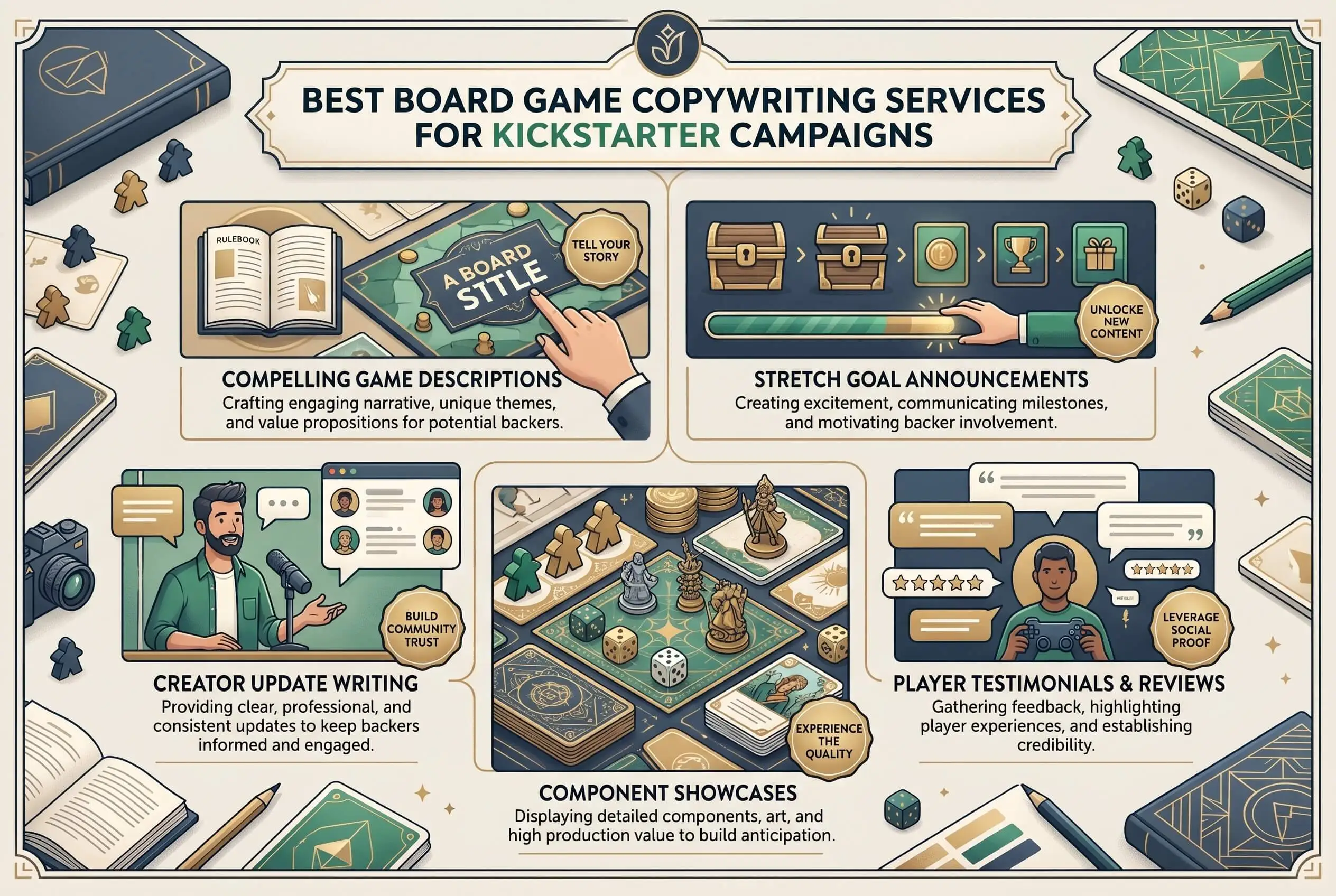
Board game copywriting services are specialist writing services for tabletop crowdfunding campaigns on Kickstarter, Gamefound, and BackerKit. A full engagement usually covers:
The campaign page and pledge tier descriptions
Stretch goal announcements and add-on copy
A pre-launch landing page that captures backer emails
Email sequences from pre-launch through the final 48 hours
Pledge manager copy inside BackerKit or Gamefound after funding closes
The work is conversion writing, not product description. Most tabletop campaigns targeting more than $25,000 in funding hire a specialist because in-house copy rarely matches how backers actually decide on pledge day, especially when the overall brand strategy behind the campaign is unclear.
Top Takeaways
Kickstarter writing is conversion copy. Treating it like a product description is the most common reason campaigns underperform their pre-launch list.
Specialists know backer psychology and the tabletop community's specific signals, which generalists usually miss for the first several campaigns of their career.
A full service covers the campaign page, every pledge tier, stretch goals, the pre-launch landing page, the email sequence, and the pledge manager flow.
Funded campaign pages follow predictable structural patterns. A trained writer applies them on purpose. A first-time creator usually applies them by accident, if at all.
Hire your copywriter six to twelve weeks before launch, alongside graphic design and video production. Sooner is fine. Later is expensive.
What Board Game Copywriting Services Cover
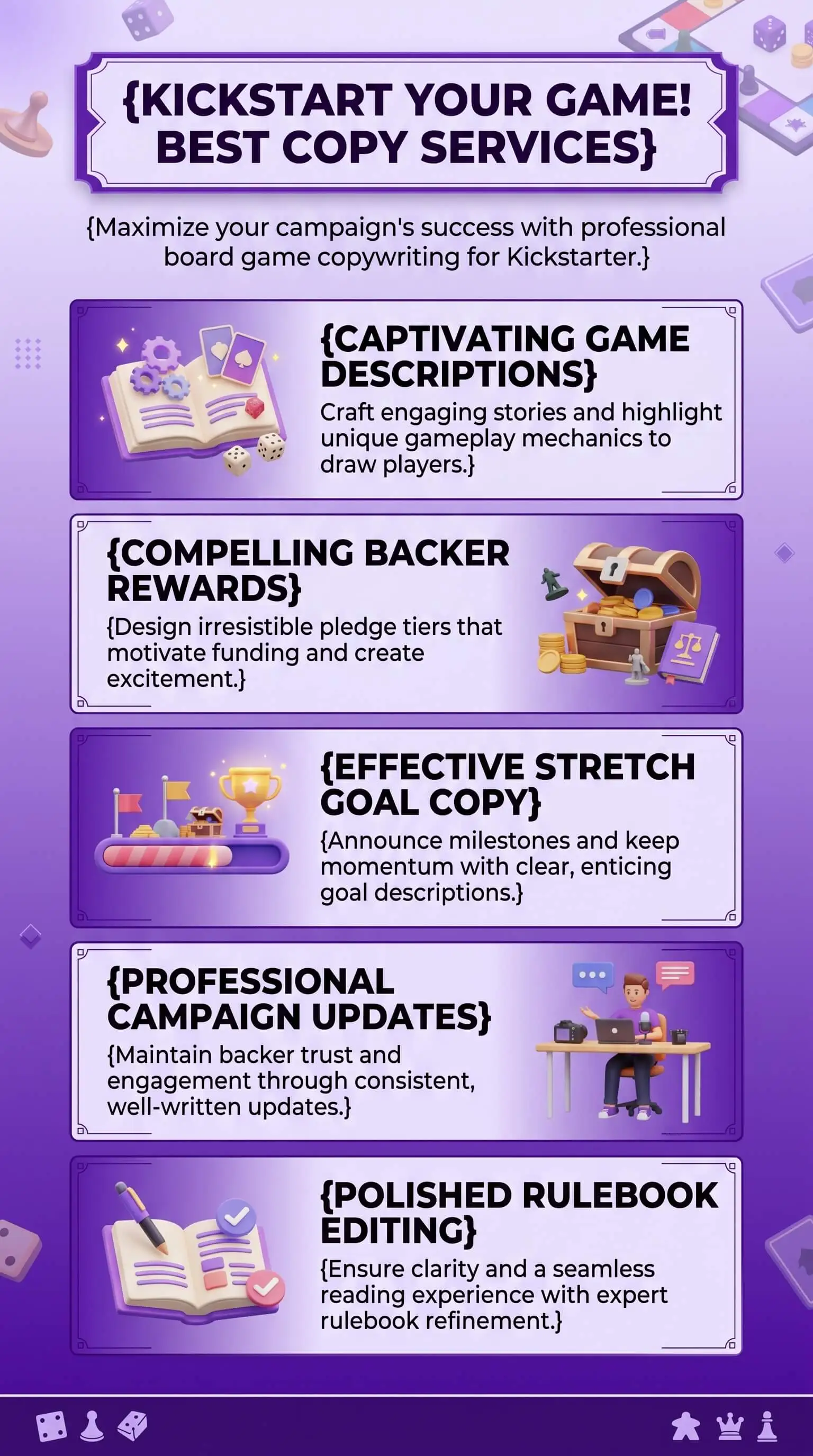
The campaign page is just the visible part. Most specialists handle the full launch package:
The Kickstarter or Gamefound campaign page itself
Pledge tier descriptions and add-on copy
Stretch goal announcements
A pre-launch landing page that captures backer emails
Email sequences for the pre-launch list, mid-campaign, and the final 48 hours
In-campaign backer updates
Pledge manager copy inside BackerKit or Gamefound after the campaign closes
The work draws on conversion writing, story craft, rulebook clarity, and the kind of fluency you only get from playing dozens of these games. A good writer takes a designer's prototype, the latest rulebook draft, and the art direction, then turns that into a page that explains the game in 30 seconds and earns the first pledge in 90
Why Kickstarter Copy Is Different From Standard Marketing Copy
A backer isn't buying a finished product. They're buying a promise from a creator they've never met, for a game that won't ship for 12 to 24 months. Standard product pages can run on features and benefits. Kickstarter pages can't, because there's no finished product to feature yet.
The page has to do something different instead. It has to explain how the game actually plays clearly enough that a stranger can picture playing it, and it has to make the creator look like someone who'll actually deliver on the promise and knows how to brand yourself online. Both jobs run on trust, not features. Without trust, no amount of beautiful art moves a pledge.
Most first-time creators end up writing their page in the voice of a product brochure. Specialists write it closer to a personal letter that happens to include pledge tiers.
What Makes a Funded Board Game Campaign Page
Looking across the top-funded tabletop campaigns from 2023 through early 2026, the same structural pattern shows up again and again:
A hook headline and a short campaign video positioned above the fold
A 30-second gameplay explanation built around one short looping GIF or video clip
Team credentials and the creator's backstory near the top, not at the bottom
Social proof from BoardGameGeek users, blind playtesters, or press coverage
A clean pledge tier ladder of three to five tiers with a clearly marked most-popular option
Honest risk-and-challenges copy that names the production realities instead of dodging them
An FAQ that handles the questions a cautious backer would otherwise email instead of pledging
When a page misses these elements, it usually underperforms whatever pre-launch list size the creator brought to it. When a page hits all of them, the campaign tends to fund early and start working through stretch goals.
How to Choose the Right Copywriter for Your Board Game
A few filters narrow the search quickly. Look for a portfolio of funded tabletop campaigns, not just general conversion writing pulled in from other industries. Ask whether the writer will play your prototype or sit through your how-to-play video before drafting a word. Many won't. Ask how they handle pledge manager copy after the campaign closes, since this is where a lot of revenue and goodwill gets gained or lost. References from creators in your funding tier matter more than the writer's biggest case study, especially when evaluating how well they understand long-term brand strategy.
Working with someone who specializes in the tabletop space, like a provider of specialized board game copywriting services, saves a lot of that learning curve. A specialist already knows BackerKit and Gamefound workflows, already reads BoardGameGeek forums, and doesn't need to be taught what a meeple is.
"Most campaign pages spend their opening paragraph describing the world the game is set in. The funded pages spend theirs explaining what the player actually does on turn one. After watching hundreds of these campaigns go live, that's the difference I keep coming back to. Theme builds the hook. The verb closes the pledge."
7 Essential Resources
Bookmark every one of these before you start drafting a page. The funded creators come back to all of them.
Wikipedia, Board Game category overview. A primer on the modern hobby, gameplay categories, and the cultural history of the medium. https://en.wikipedia.org/wiki/Board_game
Kickstarter Creator Handbook. The platform's official, regularly updated guide to running a project, covering page design, video, fulfillment, and post-campaign workflow. https://www.kickstarter.com/help/handbook
Stonemaier Games, Kickstarter Lessons by Jamey Stegmaier. Stegmaier's running archive of 200-plus posts on tabletop crowdfunding, drawn from eight successful campaigns and $3.2 million raised. The single most-cited resource for board game creators. https://stonemaiergames.com/kickstarter/lessons/
BoardGameGeek. The largest English-language tabletop community, with ratings, reviews, designer diaries, and active forums backers actually read before pledging. https://boardgamegeek.com
ICv2. Tabletop and hobby games industry news, sales rankings, and trade analysis used by publishers, retailers, and distributors. https://icv2.com
Kickstarter Tabletop Games discover page. The live feed of currently funding and recently funded tabletop campaigns, sortable by most funded, ending soon, and newest. Useful for studying what's working right now. https://www.kickstarter.com/discover/categories/games/tabletop%20games
Kicktraq. Campaign performance analytics that show daily pledge curves, backer trends, and historical comparisons across tabletop campaigns. https://www.kicktraq.com
3 Statistics
Tabletop dominates Kickstarter's Games category. In 2024, 83 percent of all Games pledges on Kickstarter went to tabletop projects. Tabletop is the biggest sub-category inside Kickstarter's biggest funding vertical, and that gap keeps widening. (Source: Kickstarter 2024 year-in-review.)
The pledge ceiling keeps moving. In April 2026, Cyberpunk TCG by Weird Co. closed at $26.9 million from 47,636 backers. That works out to roughly $565 per backer, sight unseen, for a card game that hadn't shipped a single copy yet. (Source: ICv2, April 2026.)
The middle of the market is real but modest. In 2022, more than 4,000 tabletop campaigns were funded successfully at a 76 percent success rate. The average successful campaign earned around $58,000. (Source: Game Developer reporting on Polygon analysis, 2023.)
Read those three numbers together and a pattern shows up. The category is enormous, and the top end keeps stretching higher every year while the middle stays modest, much like the competitive landscape around independent schools. Most campaigns fund. Few break out. The single biggest variable separating a $58,000 campaign from a six-figure one is how the writing handles the page.
Final Thoughts and Opinion
The tabletop crowdfunding market keeps expanding, and the top of it keeps moving faster than the middle. A solo designer with the right page can clear $50,000. A small studio with a real pre-launch list can hit half a million without a celebrity attached. The biggest campaigns clear eight figures by running every lever at once, including page copy, video, pre-launch email, paid traffic, and community heat The prototype itself is rarely the variable that decides which band a campaign lands in. The writing usually is.
Treat board game copywriting services as a campaign investment, not a line-item cost. The right copy pays back many times the fee when a campaign clears its goal a week early and starts working through stretch goals instead of scrambling for the finish line. That's why many top marketing agencies prioritize messaging strategy before ad spend. We've watched plenty of creators learn that lesson the expensive way. The ones who hire early almost never look back.
Frequently Asked Questions
How long does it take to write a Kickstarter campaign page?
Most specialist writers complete a full campaign page in three to six weeks. That window covers prototype review, the first draft, two rounds of revision, and final integration with graphic design and video.
Do board game copywriters also write rulebooks?
Some do, some don't. Rulebook writing is a separate discipline that overlaps with technical writing and game development work. Ask each writer specifically before assuming the service is bundled in.
What's the difference between a copywriter and a marketer for tabletop campaigns?
A copywriter writes the words on the page and in the emails. A tabletop marketing agency runs paid ads, list-building, influencer outreach, and audience strategy. Most successful campaigns use both, working in parallel.
Can a copywriter help with stretch goals after the campaign launches?
Yes. Many writers build mid-campaign copy into the package, including stretch goal announcements, update emails, and final-48-hour push copy. Confirm what's included before signing the engagement.
Should I hire a copywriter for a small print run or solo design?
If your funding target is under $10,000 and you're running the campaign as a hobby, doing it yourself makes sense. Above $25,000 in target funding, the math favors hiring a specialist nearly every time.
What information should I prepare before hiring a board game copywriter?
A prototype or print-and-play ready to share, your latest rulebook draft, art direction or near-final art, your target funding goal, your pre-launch list size estimate, and any creator or studio bio you want featured on the page.
Do copywriters work with Gamefound and BackerKit too?
Specialists do. The structural patterns translate cleanly across platforms, though Gamefound's page editor and BackerKit's pledge manager each have quirks worth knowing in advance.
How do I measure the return on professional Kickstarter copy?
Compare your pledge-page conversion rate, your average pledge per backer, and the percentage of your pre-launch list that converts to actual backers against published category benchmarks. If two of those three improve after hiring, the copy is doing its job.
Ready to Launch a Funded Campaign?
If you're launching a board game Kickstarter in the next six months, the copy choices you're making this week are already shaping how the campaign performs. Before you finalize the page draft, talk to a tabletop marketing specialist who works exclusively with board game creators. Hiring early lets a writer help shape the page from the start. Hiring late means paying someone to repair it, which is always more expensive than designing it right the first time.