It's March. Your CPA wants twelve months of reconciled statements, and you've reconciled two. That gap is the clearest sign a one-person business should have outsourced its bookkeeping months ago, though the earlier signs are easier to catch: bookkeeping eats a Saturday you could have billed, or you can't say what you actually earned last month.
When you work alone, you're the salesperson, the delivery team, the customer service desk, and the bookkeeper. That last job slides first. Receipts pile up in your inbox while client work takes every open hour. Outsourced bookkeeping services give business owners reliable financial support, accurate records, and timely reporting without the expense of a full-time hire. With organized books and better visibility into cash flow, you can make confident financial decisions, serve your clients, and focus on growing your business.
TL;DR Quick Answers
Outsourced Bookkeeping Services
Outsourced bookkeeping services handle your transaction recording, reconciliations, and monthly close to an outside team, so a one-person business gets accurate, tax-ready books without hiring a bookkeeper.
What's included: categorizing transactions, reconciling bank and card accounts, tracking bills and invoices, recording contractor payments, and closing the books each month with reports
Who it fits: solo owners whose books are more than a month behind, whose personal and business money share accounts, or whose bookkeeping eats into billable hours
What it costs: usually a fixed weekly or monthly fee based on transaction volume and complexity. Accountix bookkeeping starts at $200 per week.
What stays with you: your CPA still files your taxes, and you keep every financial decision
Our take: in our experience, the monthly close matters more than the software, because that's where a bookkeeper catches errors before they reach tax season
Top Takeaways
Outsource your bookkeeping when the books fall behind, cut into billable hours, or can't tell you what you earned.
Solo owners often need help sooner than larger businesses because no one else is around to catch errors.
DIY still works for simple businesses with separate accounts and a reliable monthly reconciliation habit.
Outsourced bookkeeping services handle recording, reconciliation, and the monthly close, while your CPA keeps handling taxes.
Being months behind is no reason to wait, since catch-up bookkeeping brings records without starting over.
What Bookkeeping Really Means When You Work Alone
Bookkeeping means recording every sale, expense, deposit, and payment, then reconciling those entries against your bank and card statements so the numbers hold up. Everything else in your finances sits on top of it.
Solo owners tend to lump three separate jobs together:
Bookkeeping records and reconciles what happened.
Accounting reads those records and turns them into reports you can make decisions from.
Tax preparation files your returns, usually with a CPA.
Sole proprietors generally report business income on Schedule C and pay estimated taxes quarterly. That puts four tax deadlines a year on your books, and each one gets harder when the records are behind.
7 Signs It's Time to Outsource Your Bookkeeping
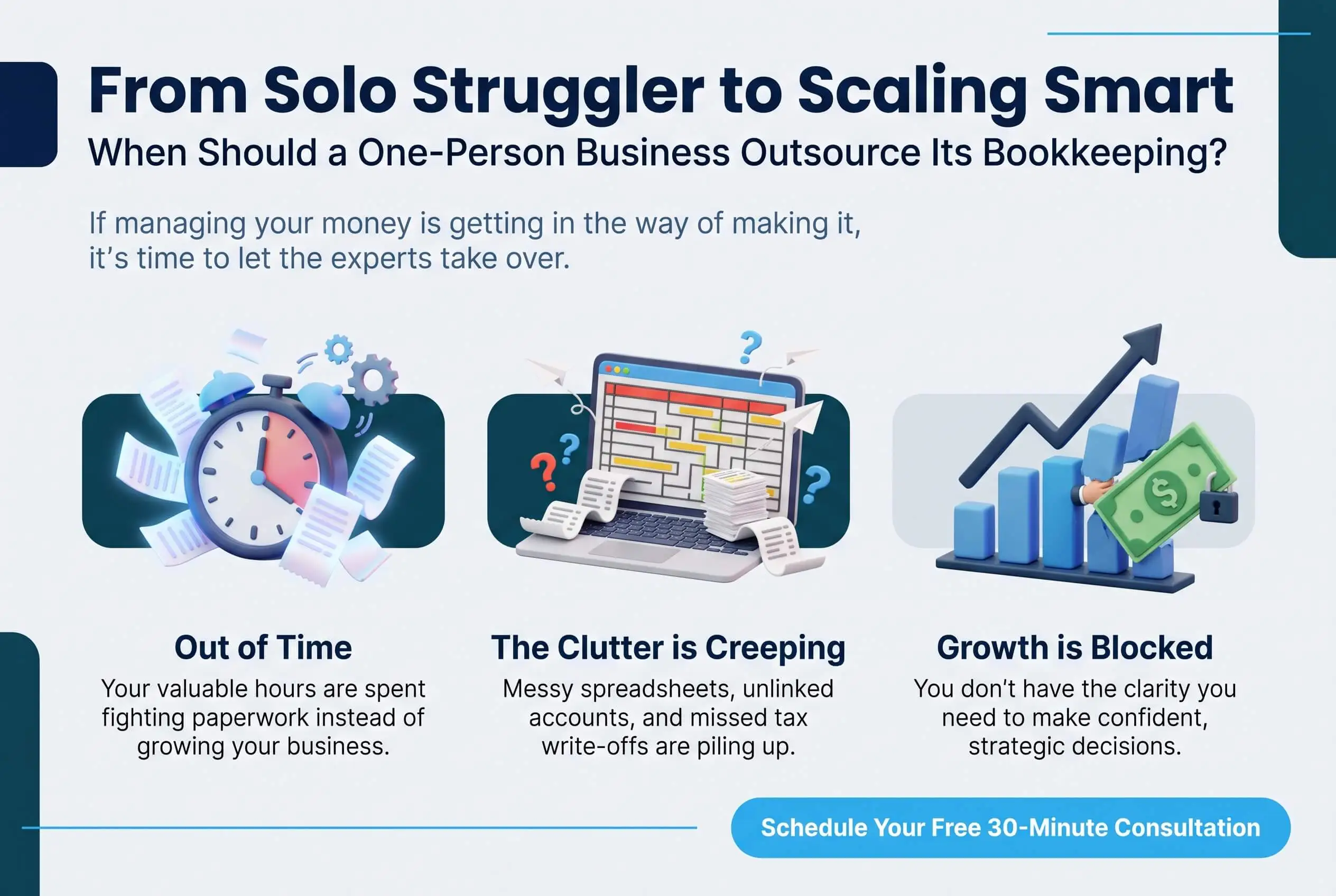
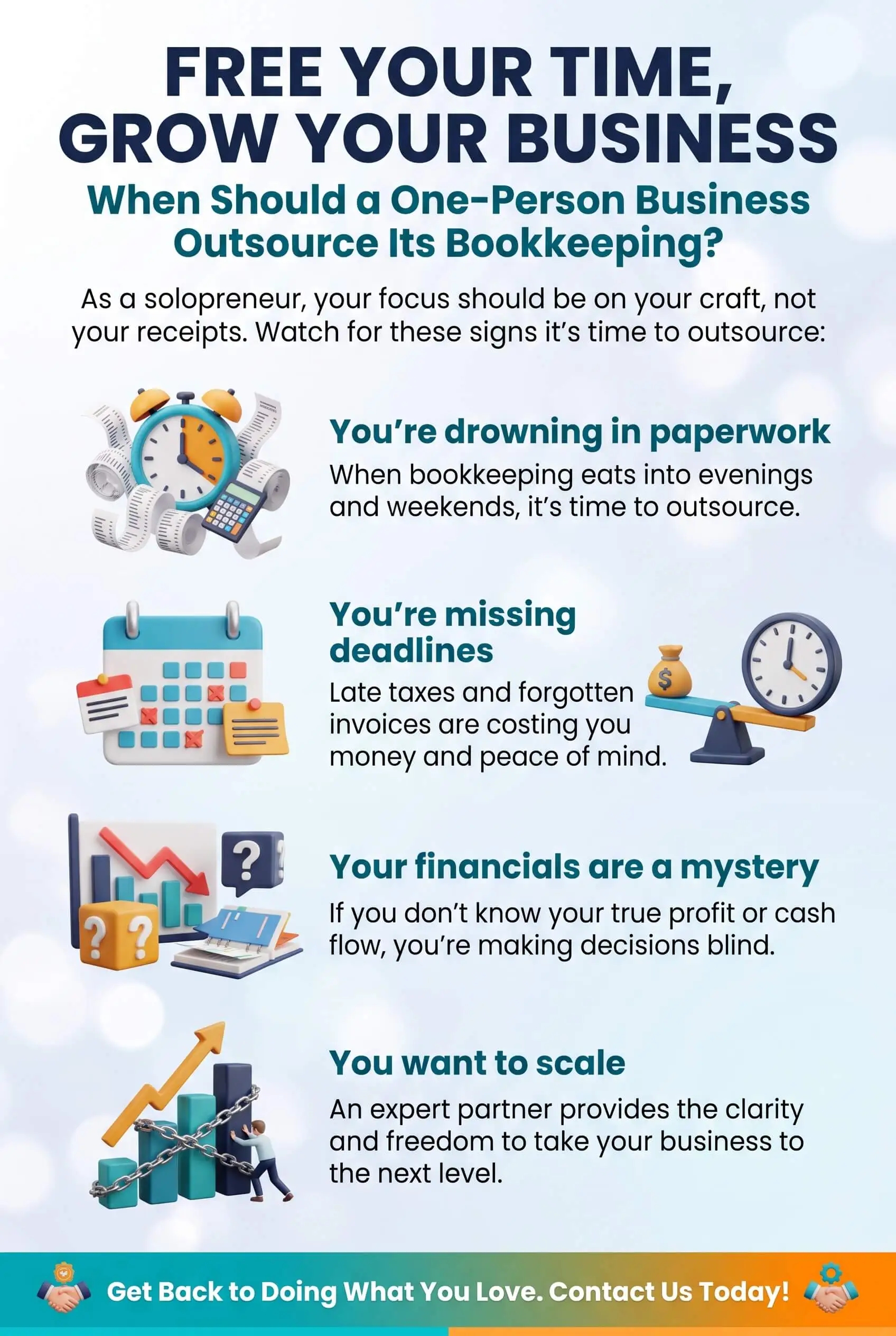
Business size has nothing to do with any of these. Each one is about what the books are already costing you.
1. Your Books Are More Than a Month Behind
One unreconciled month takes an afternoon to fix. Four months is a different job, because small mistakes compound and the paper trail goes cold. If "I'll catch up this weekend" has been the plan since spring, you still don't need to start over. Catch-up bookkeeping works forward from your bank statements and receipts until the books are current.
2. Bookkeeping Is Taking Hours You Could Bill
Do the math once. Take the hours you spend on your books each month and multiply them by your hourly rate. Six hours at $90 is $540 of billable time spent categorizing transactions. Put that next to the cost of help and most owners have their answer. Those hours could go back into client work, or into building a brand as a freelancer on zero budget.
3. Personal and Business Money Share the Same Accounts
When one card pays for groceries and software, every transaction turns into a judgment call. Was that lunch a client meeting? Commingled accounts make deductions harder to support when tax time comes. Open a separate business account first, then get help keeping it clean.
4. Tax Season Turns Into a Scramble
If your CPA spends March rebuilding your year, you're paying tax-prep rates for bookkeeping work. Missed quarterly estimates and a shaky Schedule C usually trace back to the same gap. We see it every spring. Books closed monthly and your CPA finished numbers instead of a shoebox.
5. You Can't Say What You Earned Last Month
A bank balance tells you what's in the account today. It says nothing about the invoice a client hasn't paid, the annual software renewal coming due, or the tax you'll owe on what's sitting there. If "what did I make last month?" takes you longer than a minute to answer, the books aren't doing their job.
6. Your Revenue Streams Have Multiplied
Stripe, PayPal, Square, marketplace payouts, retainers, and refunds all report on different schedules and in different formats. None of them reconcile against each other on their own. Once you're juggling three or four, bookkeeping stops behaving like a monthly chore and starts behaving like a part-time job.
7. You're Getting Ready to Hire, Borrow, or Grow
Lenders want financial statements they can trust, and so will anyone you eventually put on payroll. In the Federal Reserve Banks' 2025 Small Business Credit Survey, nearly a third of nonemployer firms said they planned to add employees within 12 months. If that's you, get the books clean first. And when your questions move from what happened to what comes next, read up on when your business is ready for fractional CFO services.
When Doing Your Own Books Still Makes Sense
Outsourcing isn't automatically the right move. Doing your own books can work well if:
You have one or two income sources and a modest number of transactions
Your business and personal accounts are fully separate
You reconcile every month and don't dread it
Your CPA isn't sending the books back with questions
If that sounds like you, keep going. Plenty of solo businesses run fine on good software and a monthly habit. Outsource when the books start costing more than the help would, and not before.
DIY vs. Outsourced Bookkeeping at a Glance
Time: DIY runs on your own hours, which usually means nights and weekends. With an outsourced team, you spend a few minutes a month answering questions.
Accuracy: You review your own work, so errors tend to surface at tax time. A bookkeeping team reconciles and reviews every month.
Tax readiness: DIY often ends in a year-end catch-up, while outsourced books are closed and ready when your CPA asks.
Cost: DIY costs software plus your time. Outsourcing costs a fixed weekly or monthly fee you can plan around.
A full-time, in-house bookkeeper almost never pencils out for a business of one. So the choice comes down to your hours or a team's.
What to Expect From Outsourced Bookkeeping Services
Most engagements cover the same six jobs:
Recording and categorizing every transaction
Reconciling bank and credit card accounts each month
Entering bills and tracking what you owe
Tracking invoices and what clients owe you
Recording payroll or contractor payments
Closing the books monthly and sending you financial reports
Monthly is the usual cadence. Your CPA still files your taxes, and your bookkeeper makes sure they're working from organized records.
Price usually depends on how many transactions you run, how complicated they are, how often you want updates, and whether the books need cleanup first. Accountix, for example, scopes each engagement after a short intro call and prices bookkeeping on a fixed basis starting at $200 per week.
Ask any provider these questions before you sign:
What's included in the quote, and what would change it?
Where is my financial data stored, and who can see it?
How will you work with my CPA?
What happens if my books are already behind?
A Quick Self-Check Before You Decide
Answer yes or no to each statement:
My books are more than 30 days behind.
I spend more than a few hours a month on bookkeeping.
Personal and business transactions share at least one account.
My CPA had to fix or rebuild my books last year.
I can't quickly say what I earned last month.
I get paid through three or more platforms.
I plan to hire, borrow, or take on a bigger client in the next year.
I avoid opening my accounting software.
Three or more yeses means a conversation with a bookkeeping provider specializing in outsourced accounting for nonprofits is worth your time. At five or more, your books are probably costing you more than outside help would.
"In our experience, solo owners fall behind when the business finally gets busy, and their comfort with numbers rarely has anything to do with it. One unreconciled month turns into three. A single miscategorized expense keeps repeating until the CPA catches it in March. When we take over those books, the fix is rarely dramatic. We close them every month, on schedule, and the owner stops guessing."
7 Essential Resources
Every source below comes from a federal agency or a nonprofit. Use them to keep cleaner records, read your own reports, and vet any provider before you hand over access.
IRS Self-Employed Individuals Tax Center covers who counts as self-employed, how quarterly estimated taxes work, and when Schedule C applies.
IRS Recordkeeping explains which records to keep, how long to hold onto them, and what you'll need to back up a deduction.
IRS Publication 583, Starting a Business and Keeping Records walks through a sample recordkeeping system, which helps if you plan to keep doing your own books for now.
IRS Estimated Taxes lays out how and when to make quarterly payments, the four dates your books need to support.
SCORE Financial Statements offers free plain-language guides and templates, plus access to volunteer mentors who'll go through your numbers with you.
SEC Beginners' Guide to Financial Statements shows how your balance sheet, income statement, and cash flow statement connect.
FTC Cybersecurity for Small Business gives you a vendor-security checklist to run before anyone gets login access to your accounts.
3 Statistics
1. Solo businesses are the majority. The U.S. had 30,427,808 nonemployer establishments in 2023, and together they brought in nearly $1.8 trillion (U.S. Census Bureau). Most of them are sole proprietorships (Census Bureau, 2023 Nonemployer Statistics). Going it alone is common, and bookkeeping help built for businesses of one exists for exactly that reason.
2. Solo owners take the financial hit personally. In the Federal Reserve Banks' 2025 Small Business Credit Survey, 64% of nonemployer firms dipped into the owner's personal funds to deal with financial challenges, compared with 54% of employer firms (2026 Chartbook on Nonemployer Firms). When business money and personal money are intertwined, clean books protect both.
3. A full-time bookkeeper is out of reach for most solo owners. Bookkeeping, accounting, and auditing clerks earned a median of $50,670 a year in May 2025, and that's before payroll taxes or benefits (U.S. Bureau of Labor Statistics). For a business of one, outsourcing is usually the only practical route to professional books.
With more than 30.4 million nonemployer businesses in the U.S., 64% of nonemployer firms relying on personal funds to address financial challenges, and full-time bookkeepers earning a median annual salary of $50,670, outsourced bookkeeping services offer a practical, cost-effective way for solo entrepreneurs and small organizations, including independent schools, to maintain accurate financial records, manage cash flow, and reduce administrative costs.
Final Thoughts and Opinion
When to outsource depends far more on timing than on how big you are. A business of one can need help as badly as a team of ten, and often sooner, because nobody else is there to catch what slips.
Here's where we land, and not everyone in our field will agree:
Waiting costs more. Books that fall behind don't fix themselves. The bill shows up at tax time, usually with interest attached.
Start with cleanup. You don't need a long contract on day one. Get current, then decide how much ongoing help makes sense.
DIY is a legitimate choice as long as you actually reconcile every month.
Software won't catch your mistakes. It automates entry, but a miscoded transaction still looks perfectly valid to it.
Good bookkeeping is also where bigger financial support begins. Owners who outgrow it eventually want forward-looking guidance, and choosing the right fractional CFO gets much easier when the books underneath are clean.
Clean books are what move a solo owner from stressed and reactive to structured. If yours are costing you weekends or your confidence in the numbers, hand them off.
Frequently Asked Questions
Is outsourced bookkeeping worth it for a one-person business?
Outsourced bookkeeping pays off for a solo owner once the hours spent on the books are worth more than the cost of help, or once errors start costing money at tax time. Most owners hit that point with multiple revenue streams, mixed accounts, or books that keep slipping. If your books are simple and current, DIY may still be enough.
How much do outsourced bookkeeping services cost for a sole proprietor?
Most providers price outsourced bookkeeping services for a sole proprietor by transaction volume, complexity, and how often you want updates, plus any cleanup the books need first. Many providers charge a fixed weekly or monthly fee instead of an hourly rate. Accountix bookkeeping, for example, starts at $200 per week. Ask every provider what the quote includes and what would change it.
What is the difference between a bookkeeper and an accountant?
A bookkeeper records and reconciles your transactions so the records stay accurate and current. An accountant reads those records, prepares reports, and tells you what the numbers mean. Most solo owners also use a CPA for tax filing. When the bookkeeping is clean, the accountant and the CPA both work faster, and their advice gets more reliable.
Can I outsource bookkeeping if my books are already behind?
Yes, and you won't have to start over. A bookkeeper reconciles your accounts against bank statements and receipts, corrects inconsistent entries, and works forward month by month until the books are current. In our experience, that cleanup is the most common starting point. Monthly bookkeeping then keeps you from falling behind again.
Will I still need a CPA if I outsource my bookkeeping?
Usually, yes. Your bookkeeper keeps the records accurate all year, and your CPA handles tax filing and planning. With monthly bookkeeping in place, your CPA works from organized numbers instead of rebuilding your year in March, which tends to save you both time and fees.
Is it safe to give a bookkeeper access to my financial accounts?
It can be, especially when an experienced Santa Barbara bookkeeper uses secure cloud software, access controls, and multi-factor authentication to help protect your financial information. A reliable bookkeeper provides peace of mind by keeping your data organized, controlling who can access it, and limiting permissions to what the job needs. The FTC's cybersecurity guidance for small businesses offers a helpful checklist for choosing a trustworthy bookkeeping provider.
Take the Books Off Your Plate
Count your yeses from the self-check. If you hit three or more, book an intro call with an outsourced bookkeeping team. It's a 30-minute conversation with no obligation, just clarity on where your books stand and what it would take to get them current.
You started this business to do the work you're good at, so let a trusted outsourced accounting firm close the books.


