Your slowest night is Tuesday. You know it, your regulars know it, and so did the three people who came in last Tuesday for sleeves and left inside four minutes.
Filling that night is a marketing problem, not a money problem. Game store marketing is how a friendly local game store, hobby shop, or game café pulls in new players and keeps the regulars coming back, and the parts that work best cost time instead of cash.
The demand is genuinely there. ICv2 puts the hobby games market up roughly 40% in 2025, at about $3.66 billion, in the seventeenth straight year of growth in the hobby channel. More players live within driving distance of your counter than did five years ago. They just don't know you exist.
So here's what to do first, what it actually costs, and how you'll know it worked.
TL;DR Quick Answers
Game Store Marketing
Game store marketing is how a friendly local game store, hobby shop, or game café pulls in new players and keeps the regulars coming back. It runs on local search visibility, in-store events, and direct contact like email, not on discounting. The moves that pay best, in order:
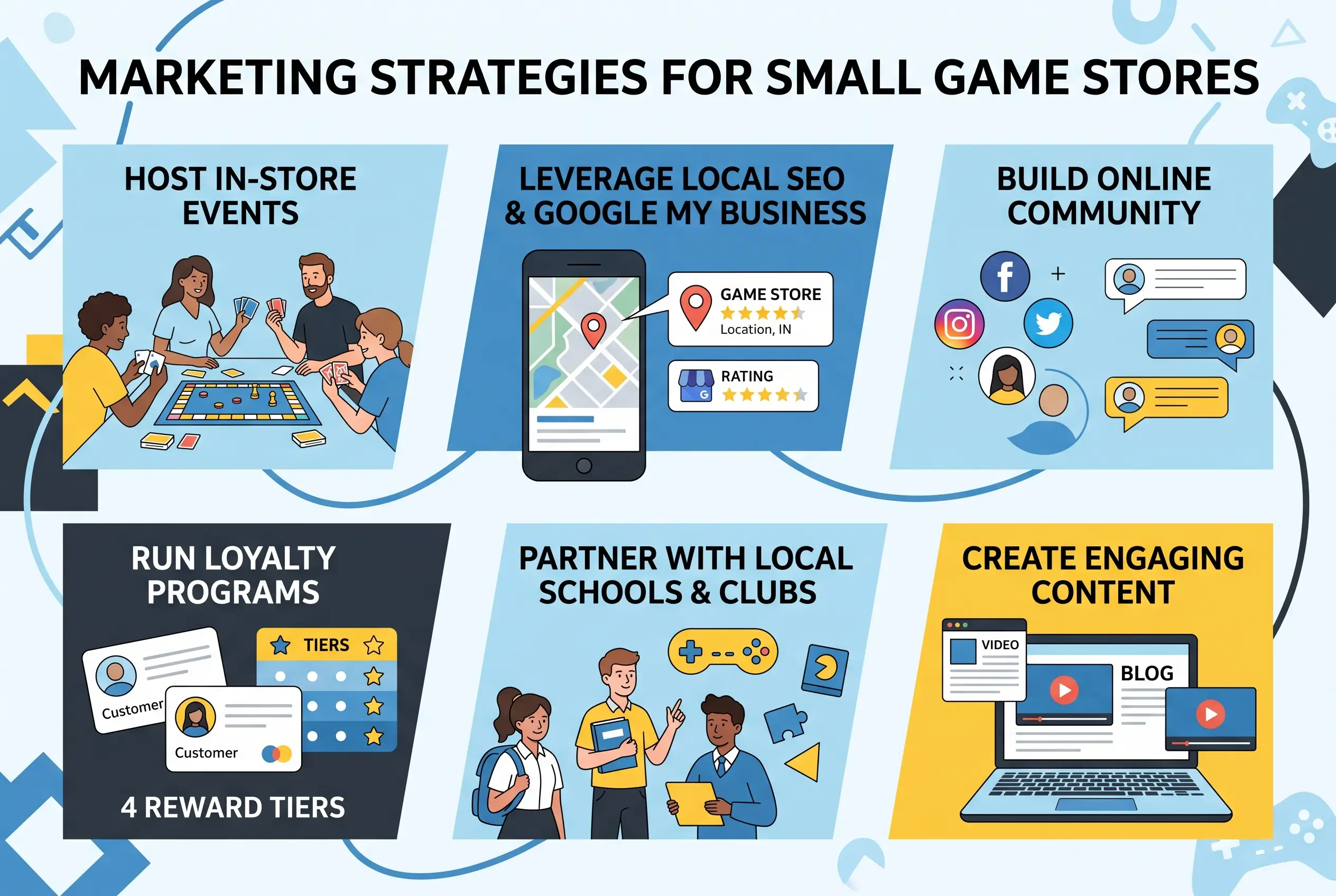
Fill out your Google Business Profile. Free, and it decides whether anyone finds you at all.
Start an email list at the register. The only channel you own outright, and the fastest way to fill a slow Tuesday.
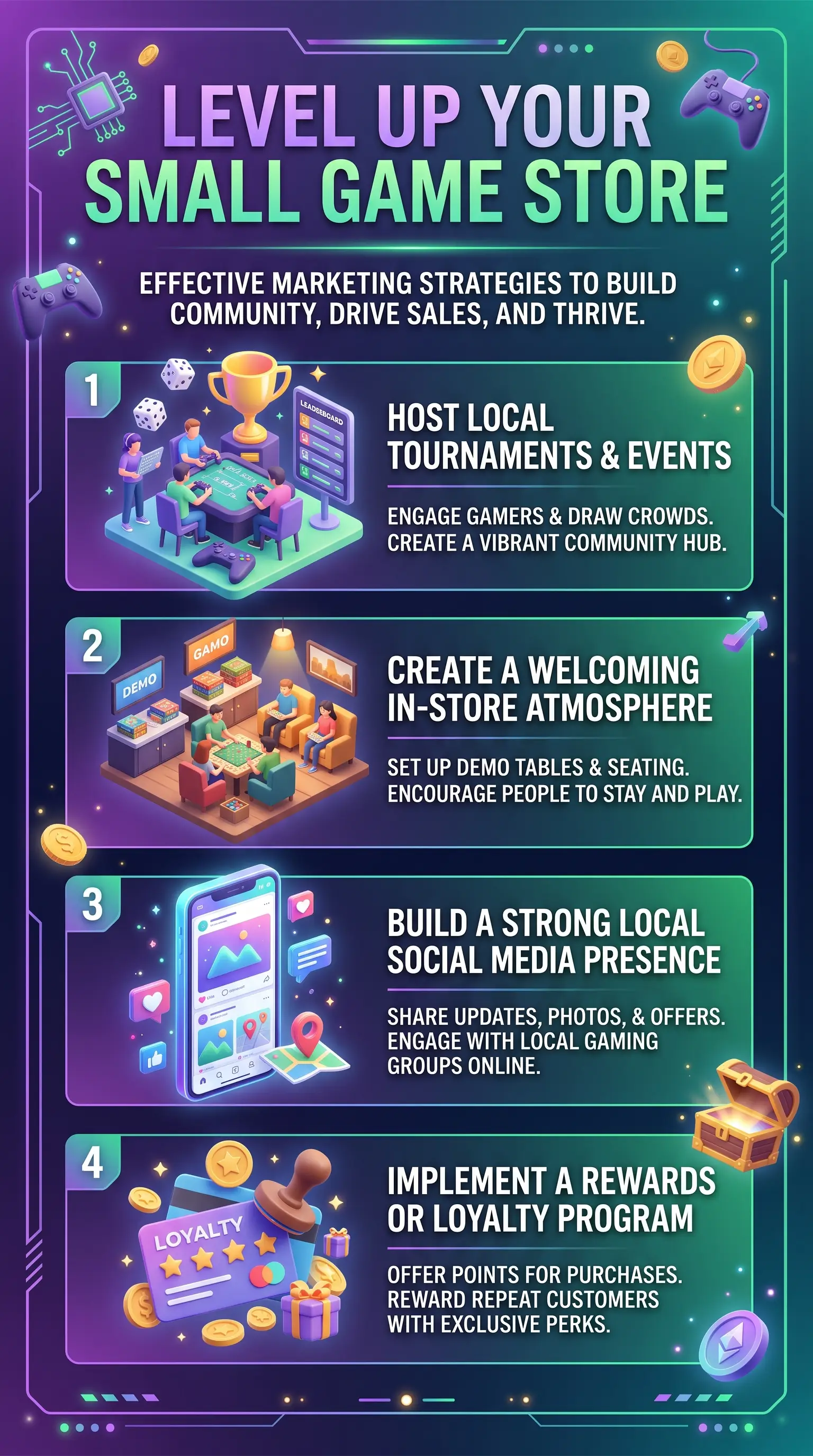
Commit to one weekly event for a full quarter. A beginner night brings in new players. Tournaments mostly serve the ones you already have.
Put your event calendar on your site as text. A Facebook widget or a photo of the whiteboard hides your best asset from Google.
Pick one social channel and post four times a week. Whichever one your regulars already open.
Spend money only once those five are running. Then a postcard drop, or a small ad budget.
Cost: the first five are essentially free. Timeline: email and events move within a week, local search takes two to three months. The catch: most small stores don't have a marketing problem so much as a sequencing problem.
Top Takeaways
The moves that pay best are free. Your Google profile, an email list, and one committed weekly event cost time, not money.
Sequence beats effort. Get findable in week one, build the list and pick your night by week four, measure in month three.
Your event calendar is your content calendar. One event has five posts. Stop inventing things to say.
Put that calendar on your site as text. A Facebook widget or a whiteboard photo hides the best thing about you from Google.
Watch four numbers, monthly. Worst-night attendance, list growth, Google calls and direction requests, new faces at events.
Give it a full quarter. Most stores drop a working tactic a week before it starts to compound.
What Game Store Marketing Actually Costs
Almost every article on this subject skips the part you actually care about, so let's start there. The highest-return moves cost time, not money. Here's the real ledger.
Google Business Profile, filled out properly. Free, about half an hour a week, and you'll usually see movement inside two to six weeks.
An email list with one send a week. Somewhere between free and $20 a month, an hour of your week. This is the one that can fill a table this week.
One social channel, posted consistently. Free, two hours a week, and give it a month before you judge it.
A weekly learn-to-play night. Costs you a demo copy and three hours. You'll see the result at the first event.
A postcard drop to the carrier routes nearest your door. USPS charges $0.26 a piece on Marketing Mail flats, plus whatever print runs you. One afternoon of setup, one to two weeks to land.
Paid social. $100 a month and up. Fastest results on the list, and the one thing here you shouldn't touch until the five above are running.
Once you've got a little budget, I'd spend it on two unglamorous things: a phone tripod, and half an hour of somebody's time to shoot your event nights properly. What I'd hold off on is a website rebuild. It feels productive, it runs into four figures, and it doesn't fix the reason nobody knows you're there.
If you want a wider frame for how this sits next to other approaches, this rundown of [marketing strategies for small businesses] covers the general principles that apply to any local shop. For game stores looking to turn those principles into search-friendly, player-focused content, board game copywriting services build on that foundation with messaging tailored to the tabletop industry.
Weeks One Through Twelve, In Order
Trying to do all of this at once is how none of it gets done. So sequence it.
Week 1
Claim and complete your Google Business Profile. Categories, real hours, event-night hours, photos of a full table instead of an empty aisle. Put a signup sheet on the counter.
Weeks 2 to 4
Send your first email, even if the list has nine people on it. Pick one weekly event and commit to it for the quarter. Ask four regulars for a Google review. Four, not twenty.
Month 2
Get your event calendar onto your website as text. Post the week's events on your Google profile. Choose your one social channel and start.
Month 3
Look at your four numbers. Only now should you consider spending anything.
Local Search Is Where The Decision Gets Made
Somebody new in town searches for a game store near them, or asks where to play Magic on a Friday, and Google hands them a short list. You're on that list or you aren't, and no amount of in-store charm changes it.
Here's the unglamorous work that decides it:
Fill out the whole profile, not just the address. Products, services, Q&A seeded with the questions you already answer at the counter, and Posts for each week's events.
Refresh your photos monthly. A busy table shot on a phone beats a professional photo of empty shelves.
Ask for reviews out loud, at the register and after events, from the people who already like you. Reviews are ranking fuel and trust signals in the same breath.
Put your event calendar on your site as real text. This is the most common technical mistake I see in tabletop retail. An embedded Facebook feed or a JPEG of the whiteboard is invisible to Google, which means the exact thing that makes you worth visiting is the one thing Google can't read.
None of that is exotic. It's ordinary [marketing](https://en.wikipedia.org/wiki/Marketing) discipline applied to a shop with dice in it, and its compounds. A page that ranks keeps working long after you've forgotten to write it.
Your Event Calendar Is Already Your Marketing Calendar
Store owners agonize over what to post while the answer is pinned to the wall behind the counter. One event gives you five pieces of content: the announcement, the reminder, a photo from the night, the recap, and the hook for next week. Run four events a month and the content calendar builds itself.
Two things small stores leave on the table constantly:
Publisher assets you're already entitled to. If you're a Wizards Play Network store, the WPN site has a marketing materials section with posters, logos, and promo images built for retailers. Free, official, and barely used.
Organized play that costs nothing to join. There's no fee to become a Play! Pokémon Store Owner, and it drops a recurring reason to visit onto your calendar along with promo cards players actually want.
The One Event Most Small Stores Skip
A learn-to-play night. Tournaments serve the players you already have. A beginner's night serves the person who's been meaning to try Warhammer for two years and is quietly terrified of walking into a room full of experts. That's your growth audience, and almost nobody's competing for them.
The same logic applies to how you talk about products. The shops that do well at a launch treat it like an event instead of a restock, which is the instinct behind good [board game copywriting for crowdfunding campaigns]: give people a reason to care before you give them a price.
The Two Channels That Bring People Back
Getting found earns you the first visit; the two channels below earn the second one.
Email is the only channel you own. No algorithm sits between you and the inbox. One short note a week, this week's events plus a restock worth knowing about plus a staff pick, will out-earn almost any ad you could buy at the same price. And a game store has a segmentation dimension most retailers would kill for: the game. The Warhammer crowd and the family-game-night crowd want different emails, and you already know which is which.
Social: pick one and stay there. Not the platform of the moment. The one your regulars already open. Painted minis, a shot of a packed table, a 60-second how-to-play, a restock. Post four times a week on one channel instead of once a week on four.
I'd add a Discord server to that. A lot of tabletop community life genuinely happens there, it costs nothing, and it does something a feed can't: it keeps your regulars talking to each other between visits.
How You'll Know If It's Working
“That Convert” is doing real work in the title, so here's the measurement half of the advice leaves out. You need four numbers, and a notebook is a perfectly good place to keep them.
Attendance at your worst event, week over week. Not your best one. Your worst one.
Email list size and open rate. When you're starting from nine subscribers, growth matters more than the total.
Calls and direction requests on your Google profile. Google reports both, and they're the closest free proxy you have for somebody deciding to come.
New faces versus familiar ones at events. Count them. If that ratio never moves, you're serving your regulars beautifully and acquiring nobody.
Check them monthly, not daily. And expect two speeds: email and events can move this week, local search takes a couple of months. The failure I see most isn't a bad tactic; it's a fine tactic abandoned in week three, one week before it would have started to compound. The same patience that helps independent schools build long-term visibility and community trust applies here, too.
When It's Worth Handing This Off
There's a point where your time is worth more behind the counter than in front of a design tool at eleven at night. Somewhere around the week you're choosing between writing the email and ordering inventory, doing it yourself stops being thrifty and starts being expensive.
If you do bring somebody in, hire for hobby fluency and not just marketing credentials. Someone who knows the difference between a prerelease and a preorder writes a copy that sounds like a person who's stood in your shop. Someone who doesn't will send you a template with the word “gamers” in it four times. For owners who want that spelled out further, there's a solid breakdown of [game store marketing help built specifically for FLGS owners] worth reading before you brief anyone.
"The stores that turned it around never found a clever tactic. They picked one night, put it on the calendar, and refused to move it for three months, including the weeks when four people showed up. Consistency reads as confidence. Players can tell the difference between a store that runs a Tuesday night and a store that's trying out a Tuesday night, and they only bring a friend to the first one."
7 Essential Resources
Every one of these is free to use or free to join. Skim whichever matches where you're stuck. All links verified July 2026.
1. Set Up The Free Thing That Decides Whether You Get Found
Google's own walkthrough for creating and verifying a Business Profile. If you only do one thing on this list, do this one.
Source: Google Business Profile Help: Get Started with Google Business Profile
https://support.google.com/business/answer/7039811
2. See What Google Already Thinks Of Your Website
Search Console is free, and it shows you which searches you turn up for, which pages are indexed, and what's broken. Most shop owners have never opened it.
Source: Google Search Console Help: About Search Console
https://support.google.com/webmasters/answer/9128668
3. Reach Every House Near Your Door Without Buying A List
USPS Every Door Direct Mail delivers to every active address on carrier routes you pick. No mailing list, no permit fees, 200-piece minimum, and postage on Marketing Mail flats currently runs $0.26 a piece. If your customers live within a few miles, this is the most underrated line in the budget.
Source: U.S. Postal Service: Every Door Direct Mail
https://www.usps.com/business/every-door-direct-mail.htm
4. Collect The Assets You're Already Entitled To
The Wizards Play Network site is the hub for WPN retailers: event calendars, program guidelines, distributor lists, and a marketing materials section with official posters and images you can use in-store and online.
Source: Wizards Play Network: Official Site for WPN Retailers
https://wpn.wizards.com/en
5. Add A Weekly Event That Costs You Nothing
There's no fee to become a Play! Pokémon Store Owner, and store owners can host casual Play! Sessions without any extra certification. Once you're eligible you can run League Challenges, League Cups, and prereleases.
Source: Pokemon.com: Run a Play! Pokémon Store & Host Events
https://www.pokemon.com/us/play-pokemon/organize/host-play-pokemon-events
6. Buy And Promote Against Real Industry Numbers
ICv2 is the trade outlet for the hobby games business. Its market coverage tells you which categories are actually growing, which is worth knowing before you decide what goes in the window.
Source: ICv2: The Business of Geek Culture, Pro Games Coverage
https://icv2.com/articles/pro-games
7. Talk To An Advisor Who Costs You Nothing
Small Business Development Centers give free, confidential consulting through nearly a thousand centers nationwide, hosted by universities and state agencies. If you want a second pair of eyes on your numbers, that's a real option at no charge.
Source: America's SBDC: Find Your SBDC
https://americassbdc.org/find-your-sbdc/
Supporting Statistics
All three were verified at primary sources. None of them are the recycled marketing-blog figures that circulate in this niche.
NUMBERED LIST × 3
Your market grew about 40% last year. ICv2 puts the hobby games market at roughly $3.66 billion for 2025, up around 40%, in the seventeenth straight year of growth in the hobby channel. Whatever else is hard right now, demand isn't your problem.
Source: ICv2: Big Growth in Hobby Games in 2025
https://icv2.com/articles/markets/view/62035/big-growth-hobby-games-2025
Five of every six retail dollars still aren't spent online. E-commerce came to 16.4% of total U.S. retail sales in 2025, and 16.9% in the first quarter of 2026 (U.S. Census Bureau). The internet isn't eating retail whole. The room you already pay rent on is an asset, not a liability.
Source: U.S. Census Bureau: Quarterly Retail E-Commerce Sales
https://www.census.gov/retail/ecommerce.html
The average household spends about $3,600 a year on entertainment. Entertainment made up 4.6% of average annual household spending in 2024, out of $78,535 total (Bureau of Labor Statistics). You're not really competing with Amazon for that money. You're competing with streaming, restaurants, and the cinema, and a Friday night at a full table is a genuinely good deal inside that budget. Say so.
Source: U.S. Bureau of Labor Statistics: Consumer Expenditures, 2024
https://www.bls.gov/news.release/cesan.nr0.htm
The statistics point to a clear opportunity: the tabletop games market continues to expand, most retail spending still happens in physical stores, and consumers consistently invest in entertainment experiences. Like ESG digital marketing and ad agencies that focus on sustainable, long-term growth, game stores benefit most from building lasting community engagement, local visibility, and memorable in-store experiences rather than relying on short-term promotions.
Final Thoughts & Opinion
Here's where I land after years of writing for tabletop businesses: small stores don't have a marketing problem so much as a sequencing problem. The advice is all out there, free, and mostly correct. What's missing is the order, the price tag, and permission to ignore nine things while you do one.
A few honest observations from the work:
Free work isn't the warm-up act. A finished Google Business Profile and a weekly email will beat a paid campaign layered on top of neither. Owners resist that, I think because free feels like it shouldn't matter this much.
Nobody quits because a tactic failed. They quit because it worked slowly. Three months is the honest minimum before local search tells you anything, and most stores stop at six weeks.
Your regulars aren't your growth. They're your foundation, which isn't the same thing. Market only to the people who already know you and you've built a very pleasant ceiling.
One caveat, because this doesn't land the same everywhere. If you're a café running on food and drink margin, weigh it differently. Your marketing sells the room and the menu first, and the games are why the room's worth sitting in.
None of this needs a marketing budget. It needs an order, and a quarter of not flinching.
Frequently Asked Questions
Q: How Much Should A Small Game Store Spend On Marketing Each Month?
You can run the highest-return work on close to nothing: a Google Business Profile, an email list, one social channel, one weekly event. Once those are steady, $100 to $200 a month covers print for a local postcard drop or a modest ad budget. Spending before the free foundation is built is the most common way I see stores waste money.
Q: What's The First Thing To Do If A Store Has No Marketing At All?
Claim and completely fill out your Google Business Profile, then put an email signup on the register. Those two, in that order, in one afternoon. Everything else here assumes people can find you and that you can reach them again without paying a platform for the privilege.
Q: How Do You Get New People Through The Door, Not Just Regulars?
Run a beginner night and say plainly in the promo that it's for beginners. Tournaments serve the players you already have. New customers are usually people who've wanted to try the hobby for months and are put off by a room full of experts. Take away the intimidation and you've taken away the barrier.
Q: Do Game Store Loyalty Programs Actually Work?
They work when they reward the behavior you actually want, which is usually attendance rather than spend. A punch card for showing up to six event nights builds a habit. A 5% discount on purchases trains people to wait for a better price. Keep it simple enough to run at a busy counter without a tablet.
Q: How Long Before Game Store Marketing Shows Results?
Email and events can change this week's foot traffic. Local search usually takes two to three months to move, then keeps paying off for years. Run the fast work and the slow work at the same time, and judge the slow work quarterly instead of weekly.
Start With Tuesday
Pick your slowest night and put one beginner-friendly event on it. Then spend an afternoon finishing your Google Business Profile and putting a signup sheet on the counter. That's the whole first week, and it costs you nothing but the afternoon. As your visibility grows, a tabletop brand game accessories e-commerce copywriter can help extend that momentum with product and category content that reaches even more players online.
If this was useful, drop a comment with the night you picked. Or send it to the shop owner in your group chat who's been meaning to sort this out since last spring.