Payroll cleared on Friday. Your P&L says the quarter went well, yet the bank balance tells a different story, and nobody on your team can say exactly why. That's the moment most owners start looking for a fractional CFO.
What you need is someone who can explain the gap and turn that insight into action. Picking the right person comes down to fit. Look for a CFO who has already worked with businesses your size and who builds forecasts instead of recapping last month, then get the scope and price in writing before you commit. Both matter more than a long résumé.
A fractional CFO brings executive financial leadership part-time, the same way any fractional executive serves a company that doesn't need them forty hours a week. Still deciding whether you need one? Start with the signs your business is ready for a fractional CFO. If you've already decided, here's how we'd compare your options.
TL;DR Quick Answers
Hire the Best Virtual Fractional Part Time CFO Services
To hire the best virtual fractional part-time CFO, choose fit over title and ask one question: what will I know in 90 days that I don't know today?
Match experience. Pick a CFO who has worked at your revenue level and in your industry.
Expect forward-looking work. That means a 13-week cash flow forecast, a budget, KPI tracking, and scenario planning rather than recaps of last month.
Get the price in writing. A fixed weekly or monthly fee with a written scope beats hourly billing. Accountix, for example, starts at $350 per week.
Check the books underneath. Every forecast depends on clean, reconciled numbers, so confirm who keeps them.
Favor a firm for ongoing support. A team gives you continuity and accounting backup that a solo freelancer can't.
Top Takeaways
Fit comes first. A CFO who has worked with businesses your size and in your industry will be useful far sooner than one with a bigger title.
Ask what they'll build for you, such as cash forecasts, budgets, and margin analysis, rather than which reports they'll send.
Get pricing and scope in writing before work starts. A fixed weekly or monthly fee is the easiest to plan around.
Somebody has to own clean books underneath the strategy, whether that's the CFO's team or yours.
The best single test for any candidate is whether they can tell you what you'll know in 90 days that you don't know now.
What a Fractional CFO Does for a Small Business
Your bookkeeper records what already happened, and your CPA keeps you compliant at tax time. A fractional CFO works on what comes next. They're a senior finance leader who joins your team part-time, usually remotely, and helps leadership make decisions from the numbers instead of from a hunch.
In our engagements, the work usually starts with a 13-week cash flow forecast so you can stay cash flow ready through timing gaps and seasonality. From there it grows into rolling budgets, margin analysis by service or client, KPI dashboards your team actually opens, and scenario planning for the big calls. Your bookkeeping still matters, whether it’s handled in-house or through remote outsourced QuickBooks bookkeeping services online. The CFO plans around it.
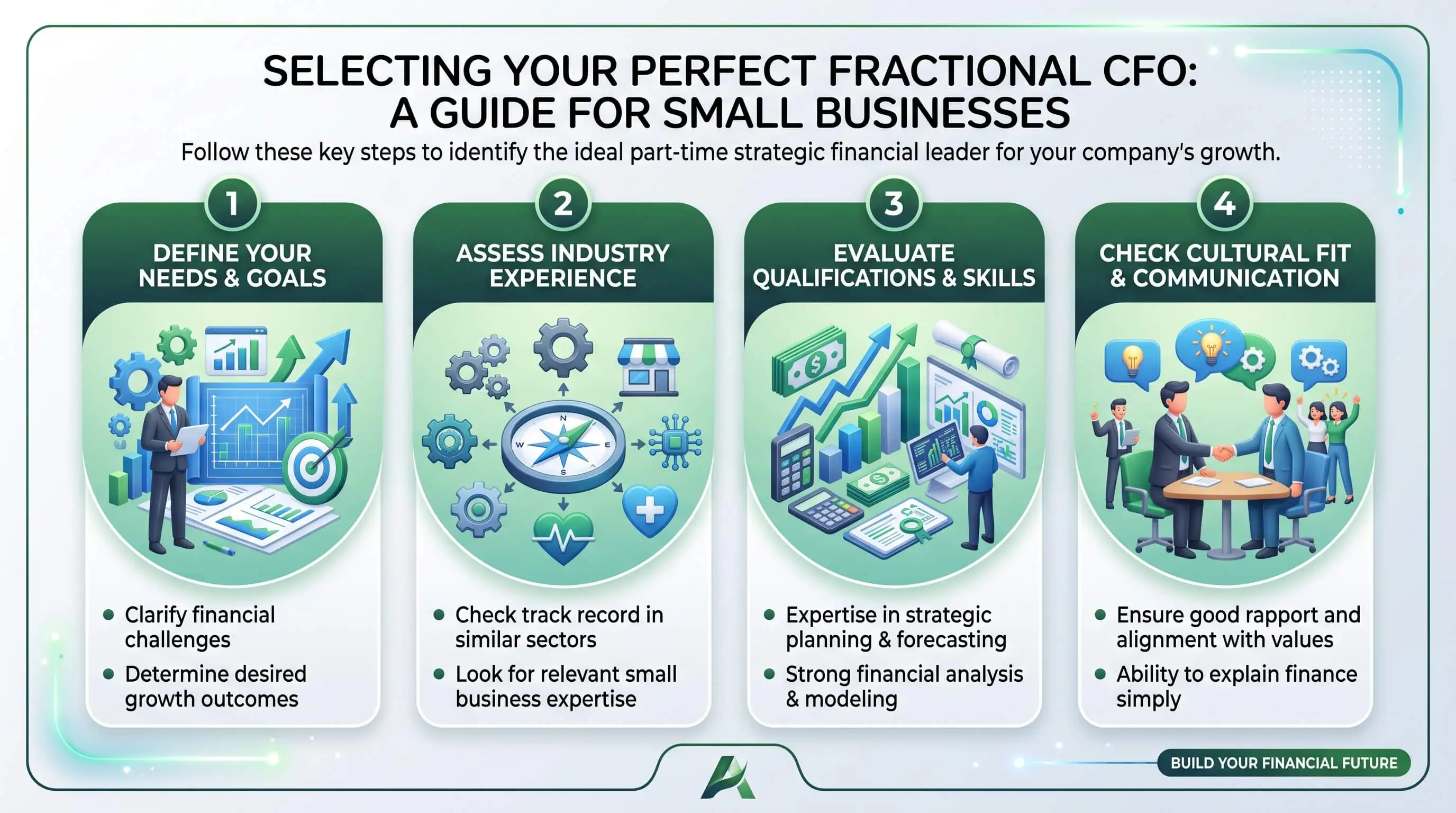
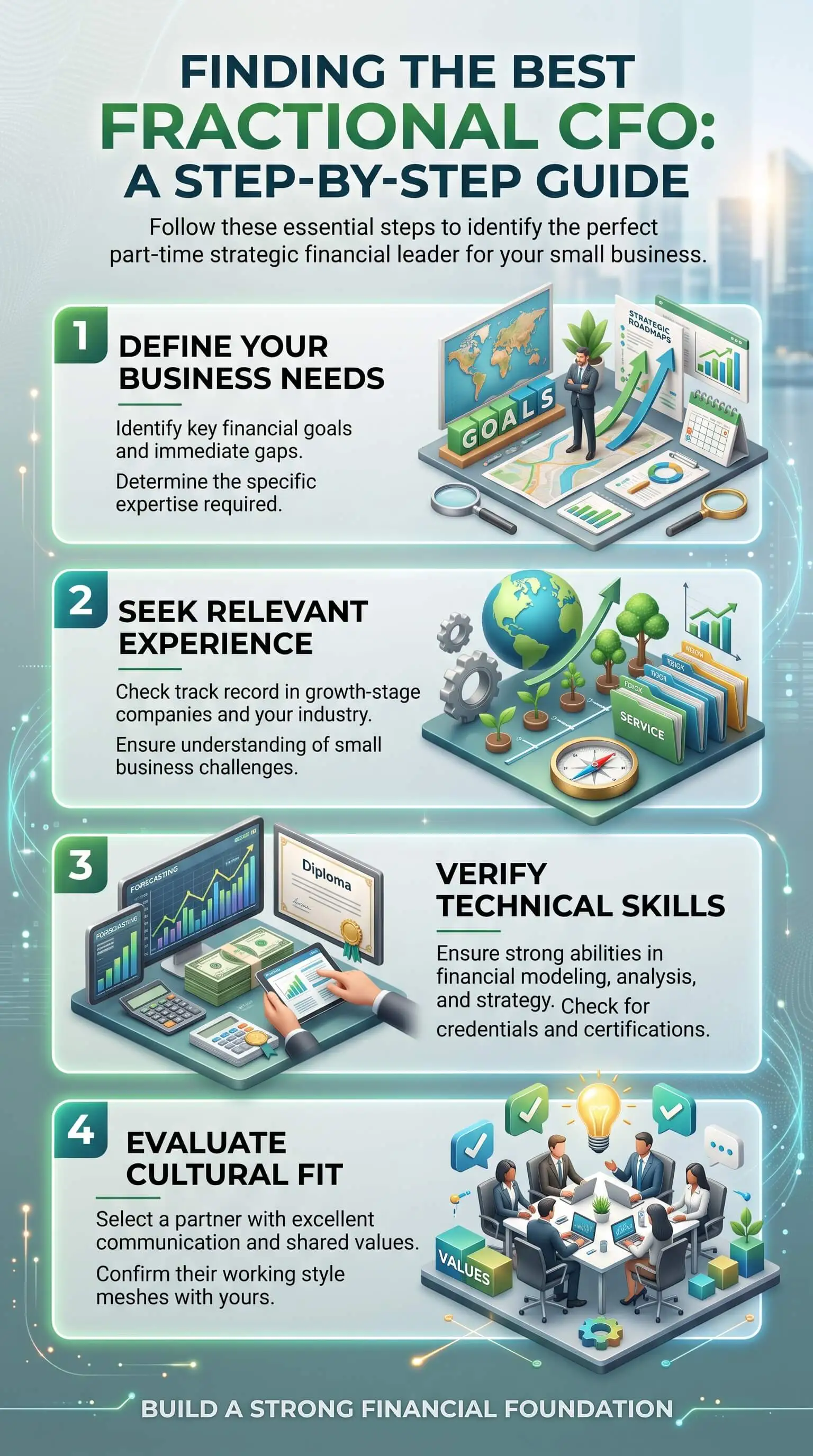
5 Criteria for Choosing the Right Fractional CFO
1. Experience with businesses like yours. Ask who they've worked with at your revenue level and in your industry, and what changed for those clients. A CFO who has guided a $3 million service firm through a hiring push will be useful within weeks. One whose background is all venture-backed startups may spend months catching up.
2. Forward-looking deliverables. You already have financial statements. So what will they build that you don't have yet? Strong answers include a pricing analysis or a hiring model tied to cash, usually built on a rolling 13-week cash forecast.
3. Access and continuity. Find out how often you'll meet and how you reach them in between. Ask whether the same person stays on your account, too, because the advice gets sharper once your CFO knows your history.
4. Comfort with your systems. If you already run QuickBooks, Gusto, and BILL, your CFO should work inside those tools rather than asking you to rebuild.
5. Pricing you can plan around. A fixed weekly or monthly fee with a written scope is far easier to budget than open-ended hourly billing. If predictable cost matters to you, look for firms that make it easy to hire the best virtual fractional part time cfo services on a fixed fee, where you agree on scope before any work begins.
Virtual, Part-Time, or Full-Time CFO: Which Model Fits?
People use "virtual" and "part-time" interchangeably, and for most small businesses the fractional CFO is both. The more useful decision is who you hire.
Freelance fractional CFO. Most charge hourly or on a monthly retainer. You get one person's calendar and nobody behind them, which works fine for a defined project on a tight budget.
Fractional CFO firm. Usually a fixed weekly or monthly fee, and controllers and accountants back up the CFO. This is the model we'd point most growing businesses toward, since the strategy and the clean books come from the same team.
Full-time CFO. Salary, bonus, benefits, and often equity. It makes sense once your business is large or complex enough to keep a finance executive busy every day.
Outsourced controller or CPA. Monthly or per-engagement fees. They're strong on accuracy and compliance and lighter on planning ahead.
How Much Does a Fractional CFO Cost?
A full-time finance executive is a six-figure commitment before benefits, and that's the main reason small businesses start fractional. What you'll pay depends on your revenue, your transaction volume, how many entities you run, and whether lenders or investors are involved.
For one concrete reference point, Accountix lists fractional CFO services starting at $350 per week and tailors the final scope to your stage and complexity. Whoever you talk to, ask for a number that is plain. And if marketing is one of your biggest expenses, it's worth reading how fractional CFOs tie marketing spend to profit.
Questions to Ask Before You Hire
Bring these to every discovery call.
Which businesses like mine have you worked with, and what changed for them?
What will I have in hand in 30, 60, and 90 days?
Who keeps the books your analysis depends on?
How often will we meet, and how do I reach you in between?
How do you set pricing, and what would make it change?
What happens if the CFO you assign to me leaves?
Ask one more before you hang up. Which clients aren't a good fit for you? A confident provider will answer that honestly.
Red Flags to Watch For
Two things worry us more than anything else on a first call. One is vagueness on questions that have simple answers, especially about deliverables and price. The other is no plan for the bookkeeping underneath the strategy, because forecasts built on messy books are just confident guesses.
Be wary, too, of a provider who offers credentials in place of results or pushes you to sign before anyone has looked at your numbers.
What the First 90 Days Should Look Like
The first month is mostly listening. A good CFO reviews your books and the systems behind them, checks your cash position, then asks which decisions you're facing this year.
By month two, you should see a work product. Expect a working cash flow forecast and budget, plus a short set of KPIs your CFO reports on a regular rhythm.
Month three is where it pays off. You sit down for the first strategy review and make at least one decision from numbers you didn't have 90 days earlier.
"The question we wish more owners asked on that first call is a simple one. What will I know in 90 days that I don't know today? When we can answer that specifically, with a cash forecast they trust or margins broken out by service line, the engagement almost always works. If a CFO can't describe it clearly, we'd keep looking."
7 Essential Resources
We send owners to these free, independent sources when they want a second opinion before signing with anyone, including us.
Wikipedia: Chief Financial Officer. A plain overview of the full CFO role. Use it to decide which pieces you actually need part-time.
BLS Occupational Outlook: Financial Managers. Shows what senior finance leaders do day to day and what the job pays when it's full-time.
SCORE: Find a Mentor. Free, confidential mentoring from experienced business owners, handy for pressure-testing a CFO proposal.
America's SBDC. No-cost advising through nearly 1,000 Small Business Development Centers. Search by state or ZIP code.
SBA Office of Advocacy: FAQs About Small Business. Federal data on small business size, financing, and survival, useful for putting your own numbers in context.
Fed Communities: Key Insights from the 2025 Small Business Credit Survey. A quick read on the funding gaps and cost pressures small employers reported last year.
Federal Reserve: 2026 Firms in Focus Chartbooks. The Fed breaks its survey results down by firm size, industry, and location. We like these for setting realistic goals before a CFO engagement starts.
These trusted resources can help business owners evaluate CFO support, financial management needs, and the best outsourced business and financial accounting firms before making a decision.
3 Statistics
1. Financial managers earned a mean annual wage of $186,910 in May 2025. That's base pay only, before benefits, bonuses, or the premium a true CFO commands. For most small businesses, it's the number that makes fractional support worth a look. U.S. Bureau of Labor Statistics
2. The U.S. has 36,207,130 small businesses, and they employ 45.9% of private sector workers. Very few will ever need a full-time CFO. Plenty will hit a stretch where they need CFO-level thinking. SBA Office of Advocacy, February 2026
3. 77% of small employer firms named rising costs, tariff-related costs, or both as a financial challenge. In the same survey, revenue expectations fell to their lowest point since 2020. When margins tighten and the outlook gets murkier, a forward-looking forecast earns its keep. Federal Reserve Banks, 2026 Report on Employer Firms
Final Thoughts and Opinion
After more than ten years of these conversations, our view is fairly settled. The right fractional CFO is the one whose first 90 days you can picture clearly, even if their rate isn't the lowest and their résumé isn't the longest.
Owners tend to over-weight credentials and under-weight fit. Someone who has already solved your kind of problem, at your size, can help almost right away. Someone who hasn't will spend a good part of your budget learning what you already know.
We'd also push back on treating strategy and bookkeeping as separate purchases. A forecast is only as reliable as the books underneath it, and if a provider can't tell you who keeps those numbers clean, their plan is resting on sand.
So pay attention to how you feel after the first call. You should come away seeing your finances more clearly.
Frequently Asked Questions
How do you choose the right fractional CFO for a small business?
Start with fit. Look for someone who has worked with businesses at your revenue level and in your industry, including independent schools where relevant. Then ask what they'll deliver in the first 90 days, how often you'll meet, and how they set pricing. The right choice answers all of it specifically and puts it in writing.
What is the difference between a virtual CFO and a fractional CFO?
The two terms overlap. "Virtual" describes where the CFO works, which is remotely, while "fractional" or "part-time" describes how much of their time you get. Most fractional CFOs who serve small businesses are virtual too. They meet by video and share dashboards online instead of working from your office.
How much does a fractional CFO cost for a small business?
It depends on your revenue, transaction volume, number of entities, and whether you're raising capital. Many firms charge a fixed weekly or monthly fee. Accountix, for example, lists fractional CFO services starting at $350 per week. A full-time finance executive, by comparison, runs well into six figures before benefits.
Is a fractional CFO firm better than a freelance CFO?
For a single, well-defined project, a freelancer can be a good fit. For ongoing support, we usually recommend a firm. You get continuity if your CFO is out, backup coverage, and an accounting team underneath, which matters a lot if your books need attention before the strategy work can start.
What should a fractional CFO deliver in the first 90 days?
Month one should cover a review of your books, systems, and cash position. By month two, you should have a working cash flow forecast, a budget, and a short list of KPIs. In month three, expect a first strategy review and at least one decision you make from the new numbers.
Do I still need a bookkeeper if I hire a fractional CFO?
Usually, yes. A fractional CFO focuses on forecasting and strategy rather than day-to-day transactions, so someone still has to keep the books accurate and reconciled. Some firms, including ours, pair bookkeeping or controller support with CFO services, so the plan rests on clean, current numbers.
Ready to Find the Right Fractional CFO?
You don't need a finished plan to start this. Write down the biggest financial decisions you expect to make over the next year, then shortlist two or three providers and book a short intro call with each. Bring the questions above. Thirty minutes is usually enough to tell whether someone can give you the clarity you're after, and a good provider won't use that time for a sales pitch.